
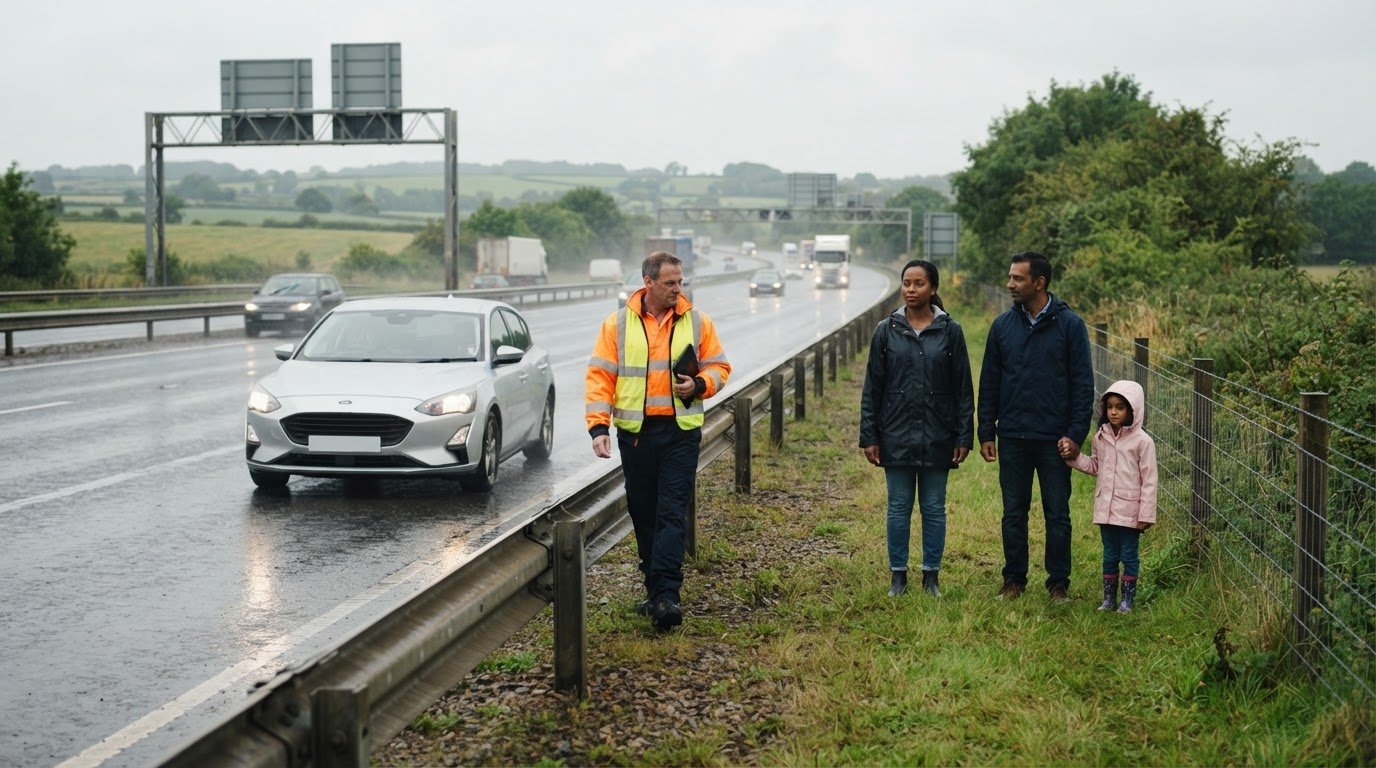
Your car starts losing power in traffic. Should you keep going or pull over? It’s a stressful moment, especially with passengers on board or fast-moving traffic nearby. Knowing what to do when car breaks down is easier when you take it one step at a time: assess what’s happening, get everyone to a safer place, then arrange the right help.
You don’t need to diagnose the fault at the roadside. You do need to know when it’s safe to move, what to do if you’re on a motorway, and when to call for assistance or recovery. This checklist covers those immediate decisions and explains what details to share when you call. Stay calm, follow the steps in order, and don’t put yourself or your passengers at risk trying to solve the problem in traffic.
Key Takeaways
- Know what to do when car breaks down by taking the first steps in order and avoiding sudden manoeuvres.
- Choose your safest next move based on where you’ve stopped, whether on an ordinary road, a motorway or away from the road.
- Use the vehicle’s behaviour, position and immediate risks to decide whether it’s safe to move or better to stop and call for help.
- Gather your exact location, vehicle details and visible symptoms before arranging assistance, but only when it’s safe.
- Consider whether roadside assistance, a jump start, tyre help, fuel delivery or recovery is the right next step.
First steps when your car breaks down: a safe checklist
Slow down, stay calm and avoid sudden manoeuvres. A warning light, loss of power or unfamiliar noise can be alarming, but first judge whether the car can reach a safer stopping place without putting anyone at greater risk. Notice how the vehicle is behaving, then choose the safest action you can.
Recognise when to stop driving
Look for warning lights, unusual smoke, a burning smell, loud or sudden noises, heavy steering or loss of power. These signs don’t identify the fault, but they may mean the car isn’t safe to keep driving. Don’t try to diagnose the problem while moving.
Ease off the accelerator and reduce speed gradually. Avoid sharp braking or steering, and watch the traffic as you look for a safe place to stop. Ask yourself whether the vehicle can reach a safer place without increasing the danger. If not, or if continuing feels unsafe, stop as soon as it’s safe to do so. Don’t press on just to reach your destination.
Take the first steps after stopping
Once you’re safely stationary, take these actions in order:
- Switch on your hazard warning lights to alert approaching traffic. In poor visibility or darkness, make the vehicle as visible as you safely can.
- Apply the handbrake. Select park if you have an automatic, or a suitable gear if you have a manual car.
- Switch off the engine once the vehicle is safely stopped. If you see smoke or suspect a fire, don’t investigate under the bonnet.
- Pause and assess your position before opening a door or getting out. Traffic, the road layout and your surroundings affect what’s safest next.
Don’t attempt a roadside check if it would put you close to moving traffic or expose you to another immediate hazard. Keep your attention on your surroundings, not just the dashboard. If the car has stopped somewhere unsafe, focus on protecting yourself and your passengers rather than trying to fix it there.
Your first priority is a safe stop, not a roadside repair.
Once stopped, consider whether the warning signs have settled or whether there’s still an obvious risk. A warning light accompanied by smoke, a strong burning smell or continuing loss of power is a reason not to resume the journey. Even if the car appears to run again, don’t assume the problem has passed. If moving it would take you into traffic or make the situation more dangerous, stay put and arrange suitable help. The safest choice depends on both the vehicle’s behaviour and exactly where it has stopped.
What to do if your car breaks down on a road or motorway
The safest action depends on the road around you. A hard shoulder, an emergency refuge area and a quiet car park each call for a different response. Use this comparison to orient yourself, but never step into traffic or put yourself at risk to follow a checklist. If a suggested action would be unsafe in your situation, stay out of danger and call for help.
| Where you’ve stopped | Safest general action | Main hazard to avoid |
|---|---|---|
| Motorway | If safe, leave at the next exit or reach the hard shoulder. | Standing beside live traffic or trying to place a warning triangle. |
| Smart motorway | Use an emergency refuge area or exit if safely reachable; follow signs and lane signals. | Stopping in a live lane or driving under a Red X. |
| Ordinary road | Move to a safe place away from moving traffic if possible. | Getting out where visibility is poor or traffic is close. |
| Home or car park | Stop clear of entrances, exits and vehicle routes. | Blocking traffic or standing where vehicles are manoeuvring. |
If you stop on a motorway or smart motorway
If the car can reach the next exit or a place of relative safety without creating further danger, continue cautiously to it. Otherwise, use the hard shoulder where available. On a smart motorway, use an emergency refuge area if you can reach one safely, then follow the instructions there to contact the regional control centre. Never cross lanes to reach a refuge or drive in a lane marked with a Red X. If you’re stranded in a live lane and can’t get out safely, remain in the vehicle with your seatbelt fastened and call 999.
Once stopped on a motorway, leave by the left-hand doors if it’s safe, then wait behind the safety barrier, well away from traffic. Follow current National Highways instructions and any signs or signals at your location. The Highway Code says not to place a warning triangle on a motorway. Don’t walk along the carriageway to find help.
If you stop on another road, at home or in a car park
On an ordinary road, move away from live traffic only if you can do so safely. A bend, narrow verge, poor lighting or fast traffic may make getting out more dangerous than remaining in the vehicle. The Highway Code advises placing a warning triangle at least 45 metres behind a broken-down vehicle on other roads, but only if it’s safe to do so. Never use one on a motorway.
At home or in a car park, moving vehicles can still pose a risk. Keep clear of driveways, access routes and manoeuvring areas. A breakdown at home may let you arrange help away from roadside traffic, but on a public road your position and visibility matter as much as the fault. If the vehicle can’t be dealt with safely where it is, roadside assistance and recovery can be a practical next step.
Can you move the car, or should you stop and call for help?
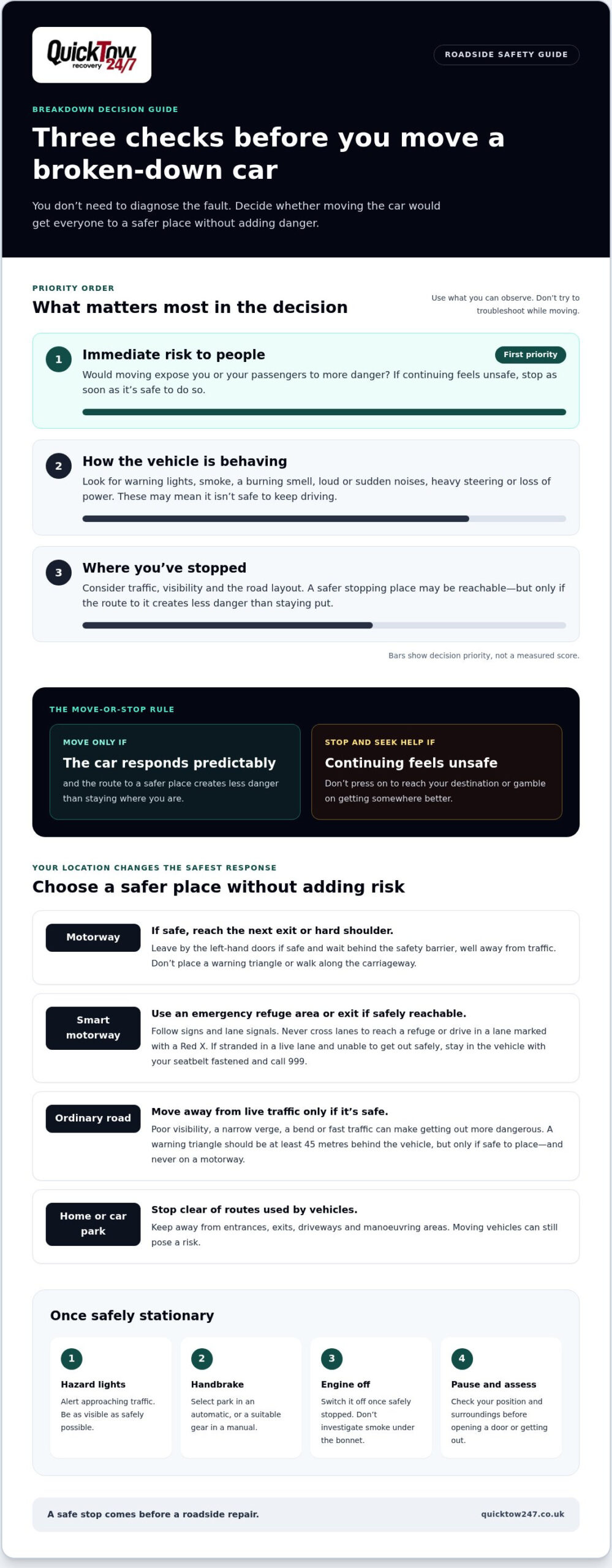
Check three things before deciding whether to move: how the vehicle is behaving, where it has stopped and whether moving would increase the immediate risk. You don’t need to identify the fault. Focus on what you can observe and whether the car responds safely enough to reach a better stopping place.
Move the car only if it responds predictably and the route to a safer place creates less danger than staying put. If you’re unsure, don’t gamble on reaching a destination. The answer to what to do when car breaks down isn’t always to keep driving, even for a short distance.
When moving to a safer place may be possible
Consider moving only if the steering and brakes feel dependable, the vehicle remains under control and there’s no sign of an immediate hazard. For example, if the car has lost power but still responds normally, a nearby exit or safe off-road stopping place may be reachable. Keep the move short and cautious. Don’t accelerate hard or try to keep pace with traffic if the vehicle is struggling.
Stay alert as you move. If the problem worsens, the car behaves unpredictably or a warning suggests immediate danger, stop again as soon as you can do so safely. Don’t continue just because you’ve already started moving. The aim is to reach a safer stopping place, not to complete the journey.
When to stop and request assistance
Stop and arrange help if you’re losing control, the car is difficult to steer or brake, or you see smoke or signs of overheating, such as steam or a temperature warning. These symptoms can make further driving unsafe. Don’t open the bonnet to investigate if smoke or heat is present, and don’t attempt a roadside repair beside fast-moving traffic or anywhere you could be struck.
Road position matters too. A vehicle that might be manageable on a quiet driveway could be dangerous in a live lane, on a blind bend or beside fast traffic. If your position puts you or others at immediate risk, prioritise safety and seek urgent help. On a motorway, follow the appropriate emergency procedure for your exact location rather than trying to reach help on foot.
This simple decision framework can help when you’re stressed:
- Vehicle behaviour: Does it respond predictably, or are control, power or warning signs getting worse?
- Road position: Can you reach a safer place without crossing traffic or making a risky manoeuvre?
- Immediate risk: Could continuing, getting out or checking the car put anyone in danger?
If any answer points to danger, stay stopped and request roadside assistance or recovery. This is safety guidance, not a remote diagnosis. A proper assessment is needed to establish what the vehicle requires. If the car can’t safely continue, breakdown recovery and roadside assistance can help you arrange a suitable next step.
What information to prepare before asking for breakdown help
You don’t need every detail ready before calling. First make sure it’s safe to use your phone. Then share enough information for the person arranging help to understand where you are, what vehicle needs assistance and what you can see happening. Clear observations are more useful than a guess about the fault.
Pinpoint your location and describe the problem
From a safe position, check road signs, junction names, nearby landmarks or the direction you’re travelling. On a motorway, give its number, direction and the nearest junction or marker post if you can see one. A location-sharing tool such as what3words can help narrow down your position, but give road details or landmarks too. Don’t leave a safe place to look for a sign.
Describe the vehicle and symptoms in plain terms. Useful details include:
- Location: road name or number, direction of travel, nearby junction, exit or landmark.
- Vehicle: registration, make, model, colour and type, such as a car or van.
- Visible symptoms: for example, the engine won’t start, a tyre is flat, there’s smoke or the vehicle has lost power.
Say what happened and when. For instance, “The car lost power just after the roundabout and is stopped in a lay-by” is clearer than “It’s broken”. Don’t guess what caused the problem. If a dashboard warning is visible, describe it or read its wording if you can do so safely.
Make the call easier and safer
Keep your phone accessible and provide a safe callback number when arranging help. If the signal is poor, say so. Mention if the vehicle is in a hazardous position, access is difficult, or you have children, older passengers or anyone who needs extra support with you. These details help the person handling the request understand the situation and any immediate safety concerns.
Gather information only when it’s safe. Don’t walk beside traffic to check a sign, inspect the vehicle or take photographs. If you can’t check a detail without risk, say what you know and explain what you can’t see.
Breakdown cover and call-out charges depend on the arrangement you use, so keep those questions separate from the urgent location and safety details. When arranging help, request breakdown assistance and share the clearest safe location details you have.
When breakdown recovery is the right next step
Roadside help is the right next step when the car can’t safely continue, the fault isn’t something you can resolve without risk, or your stopping place leaves you exposed to traffic. The type of assistance depends on what’s happening and where the vehicle is. A jump start, tyre help or fuel delivery may address a specific roadside problem. If the car remains unsafe to drive, towing may be more suitable.
You don’t need to identify the mechanical cause before asking for help. Explain what you can see, where the vehicle is and whether it can move safely. These details help the recovery team understand the situation and arrange an appropriate response.
Match the help to the problem
Describe the issue plainly and let the situation guide the next step. If the car won’t start and the battery appears flat, jump-start assistance may be appropriate, but it can’t guarantee the vehicle will restart or be safe to drive afterwards. If a damaged or flat tyre prevents a safe journey, request tyre assistance. If you’ve run out of fuel, emergency fuel delivery may help you continue once it’s safe to do so.
Choose towing if the vehicle can’t safely continue, or if its position or condition makes roadside assistance unsuitable. Don’t drive on a tyre you believe is unsafe or continue after serious warning signs just to reach a garage. The safest option depends on the vehicle’s condition and location.
Arrange help with QuickTow 24/7
QuickTow 24/7 provides nationwide vehicle transportation, towing and vehicle recovery, alongside breakdown recovery and roadside assistance across the UK. Services include power jumpstart, mobile battery changing, vehicle pullout from a ditch, mud or ice, mobile tyre replacement or repair, emergency refuelling and towing. The service is available 24/7. QuickTow 24/7 states that response times are 10-45 minutes in most cases, but this isn’t a guaranteed arrival time. Recovery is fully insured.
Contact QuickTow 24/7 to arrange suitable assistance on +443301335868 or via WhatsApp on +447867797404. Share your location, vehicle details and visible symptoms, and mention any access problem or immediate safety concern. If the car is in a dangerous position, say so at the start of the call or message. A clear description helps the team understand whether roadside assistance or recovery is the more suitable next step.
When deciding what to do when car breaks down, match the help to the risk rather than pushing on regardless. You can’t control every delay or fault, but you can explain the situation clearly and avoid an unsafe journey.
Prioritise safety, share your location and arrange suitable help.
Be ready to make the next move
A breakdown can disrupt your plans, but you don’t have to solve everything at once. If you’re unsure what to do when car breaks down, focus on making the safest decision you can with the information in front of you. Don’t risk your safety to keep moving or investigate a fault. Getting suitable help is a sensible next step when the vehicle can’t continue safely.
QuickTow 24/7 provides breakdown recovery and roadside assistance across the UK. The service is available 24/7, with a stated response time of 10-45 minutes in most cases, not a guaranteed arrival time. Recovery is fully insured.
Need breakdown recovery or roadside assistance? Contact QuickTow 24/7 and share your location and what’s happening. Take it one step at a time and put safety first.
Frequently Asked Questions
What should I do first if my car breaks down?
Ease off the accelerator, avoid sudden steering or braking, and look for a safe place to stop. Once stationary, switch on your hazard lights, secure the car and assess your surroundings before getting out. If you’re searching for what to do when car breaks down, remember that the safest action depends on your road position. Follow the relevant official guidance for the road you’re on, especially on motorways.
Can I leave my car if it breaks down on a motorway?
Leave the car only if you can do so safely. If stopped on a hard shoulder or in an emergency refuge area, use the left-hand doors and wait behind the safety barrier, away from traffic. If you’re in a live lane or getting out would expose you to danger, stay inside with your seatbelt on and call 999. Follow current National Highways advice for your exact motorway situation.
Should I put a warning triangle behind my car on a motorway?
No. The Highway Code says not to use a warning triangle on a motorway. Don’t walk along the carriageway or hard shoulder to place one, even if you’re concerned that approaching drivers may not see your car. Use your hazard lights and follow the motorway’s safety instructions instead. On other roads, the guidance differs, but only place a triangle if you can do so without putting yourself near traffic.
Can I call for breakdown help if I do not have breakdown cover?
Yes. You can contact a breakdown recovery service and request assistance even if you don’t have an annual breakdown policy. Explain that you’re arranging help for a single incident, then give your location and a clear account of what has happened. If you have a cover provider, check whether its terms apply to this breakdown. Don’t delay seeking help if the vehicle or its position creates a safety risk.
What information should I give when I call for breakdown assistance?
Give your location first, including the road number, direction of travel, nearest junction or a recognisable landmark. Then describe the vehicle by registration, make, model and colour. Explain what you observed, such as a flat tyre, failure to start or smoke, without guessing at the cause. Tell the person arranging help if the car is difficult to access, blocking a route or carrying passengers who need extra support.
Should I keep driving if my car shows a warning light after breaking down?
Not automatically. Check the warning symbol and your vehicle handbook once you’re safely stopped. Some warnings may call for caution or a check before continuing; others, especially alongside smoke, overheating signs, loss of control or unusual noises, can mean driving is unsafe. Don’t rely on a light disappearing as proof the problem has passed. If you’re uncertain, stop in a safe place and seek assistance rather than risk worsening the situation.
What should I do if my car breaks down in a dangerous position?
Put personal safety first. If you’re stopped in a live lane or another position where a collision seems an immediate risk, call 999. On a motorway, if you can’t exit the vehicle safely, remain inside with your seatbelt fastened and contact emergency services. Don’t try to push the car, inspect it or cross traffic. Tell the call handler your location, direction of travel and what makes the position dangerous.