
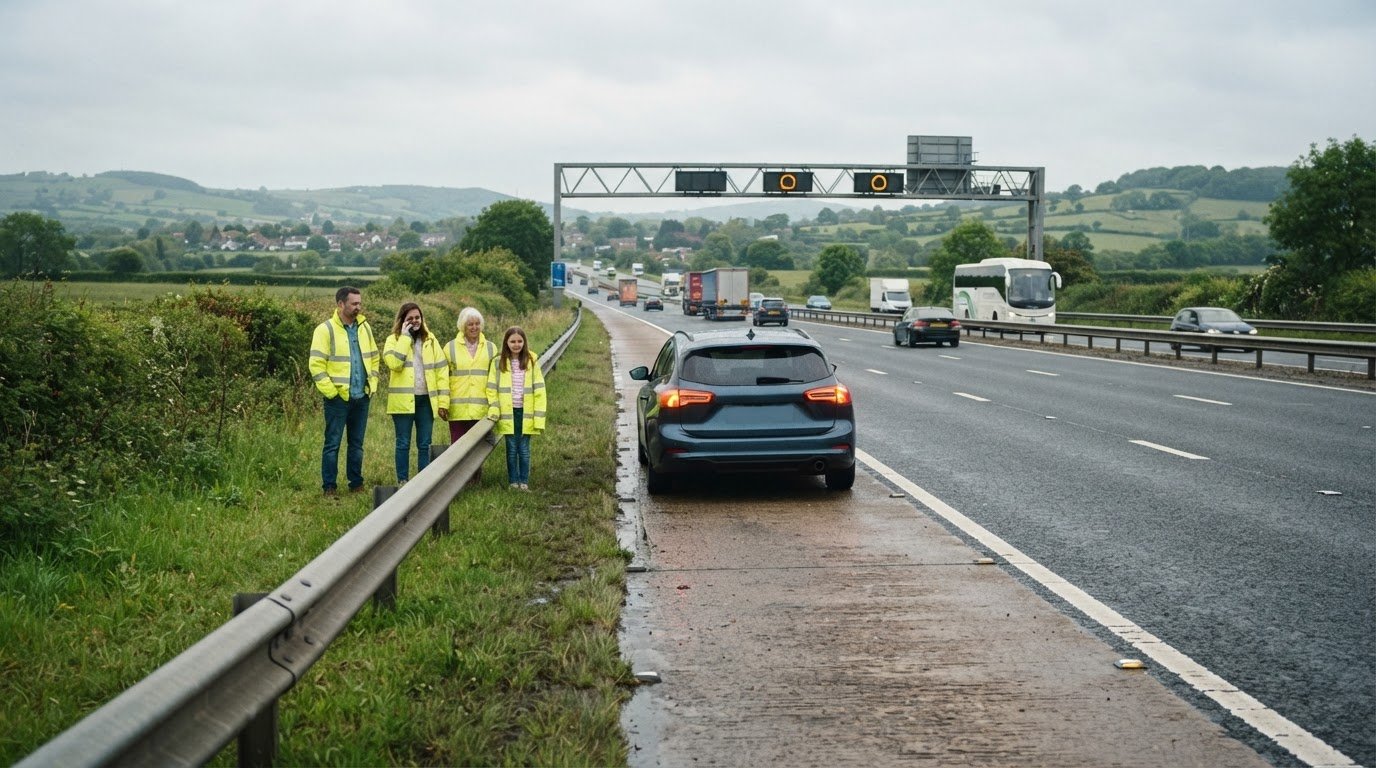
What should you do if your car breaks down on a motorway? The motorway hard shoulder breakdown rules depend on exactly where you stop. A permanent hard shoulder, a smart motorway emergency area and a live lane each call for different decisions.
It’s understandable to feel unsure, especially when deciding whether to leave the car or stay inside. The Highway Code’s key message is to go left where you can. If the vehicle can still move safely, aim for the next junction or service area. If it can’t, the safest steps depend on whether you reach a hard shoulder or an emergency refuge.
This guide explains what to do first, how to reduce risks for you and your passengers, and what changes on smart motorways or when you’re stranded in a live lane. You’ll also learn what information to share when arranging help, so you can focus on the next step without working everything out under pressure.
Key Takeaways
- The motorway hard shoulder breakdown rules depend on where you’ve stopped. Identify whether you’re on a hard shoulder, in an emergency area or in a live lane.
- If you reach a hard shoulder, follow the safety steps in order and keep clear of moving traffic.
- On a motorway without a permanent hard shoulder, follow the emergency area instructions and use the SOS phone if you can reach it safely.
- Know which Highway Code instructions apply and which common actions could put you or your passengers at greater risk.
- Once you’re in a place of relative safety, share your motorway, direction of travel, nearest marker or landmark, vehicle details and position when arranging recovery.
Motorway hard shoulder breakdown rules: first identify where you have stopped
Put people before the vehicle. A car can be recovered, but a person exposed to moving motorway traffic is at immediate risk. Before deciding what to do next, work out where the vehicle is and whether it can move safely. The motorway hard shoulder breakdown rules depend on your location, so the safest available stopping place can vary.
What counts as a place of relative safety on a motorway?
Highway Code Rule 275 describes a place of relative safety as somewhere the risk of being hit by another vehicle is low. Examples include a motorway service area, an emergency area, a hard shoulder or a lay-by. “Relative” matters: these places don’t offer equal protection, and none should be treated as risk-free.
A service area is separated from the live carriageway and is generally a safer place to stop than the hard shoulder. The shoulder gives some space away from the traffic lane, but fast-moving vehicles pass close by. It’s a stopping place for an emergency, not a protected refuge. This Hard shoulder overview explains its general purpose and use, including in the UK.
Which motorway situation are you in?
Look at the road around you, not just the dashboard. A conventional hard shoulder is the continuous strip to the left of the carriageway, usually separated from the left-hand lane by a solid white line. An emergency area is a designated refuge on some smart motorways, marked by blue signs. A service area is a separate facility reached by an exit from the motorway.
Some smart motorway layouts have no continuous hard shoulder. Others may open a hard shoulder as a running lane at busy times. A live lane is any lane carrying traffic, including a lane that may be closed by a Red X. Don’t assume a space beside the carriageway is safe simply because it looks like a shoulder.
Quick location check
- Service area: You’re off the main carriageway, in a dedicated stopping facility.
- Emergency area: You’re in a signed refuge beside the carriageway.
- Hard shoulder: You’re on the marked strip at the left edge of the road, if one is present and not operating as a live lane.
- Live lane: You’re still in a lane used by moving traffic, or can’t safely reach a designated refuge.
If the vehicle can still move without creating a greater danger, the next junction, service area or signed emergency area may offer a safer stopping place. If it can’t, don’t take a risky chance just to reach one. First identify your position. The right next step depends on what is safely within reach.
Broken down on the hard shoulder? Follow these safety steps
Once you’ve reached the hard shoulder, keep the next moves simple. The motorway hard shoulder breakdown rules put distance from moving traffic first. Don’t stay beside the car to inspect damage or try a repair. If the vehicle is stopped in a dangerous position or anyone is injured, call 999.
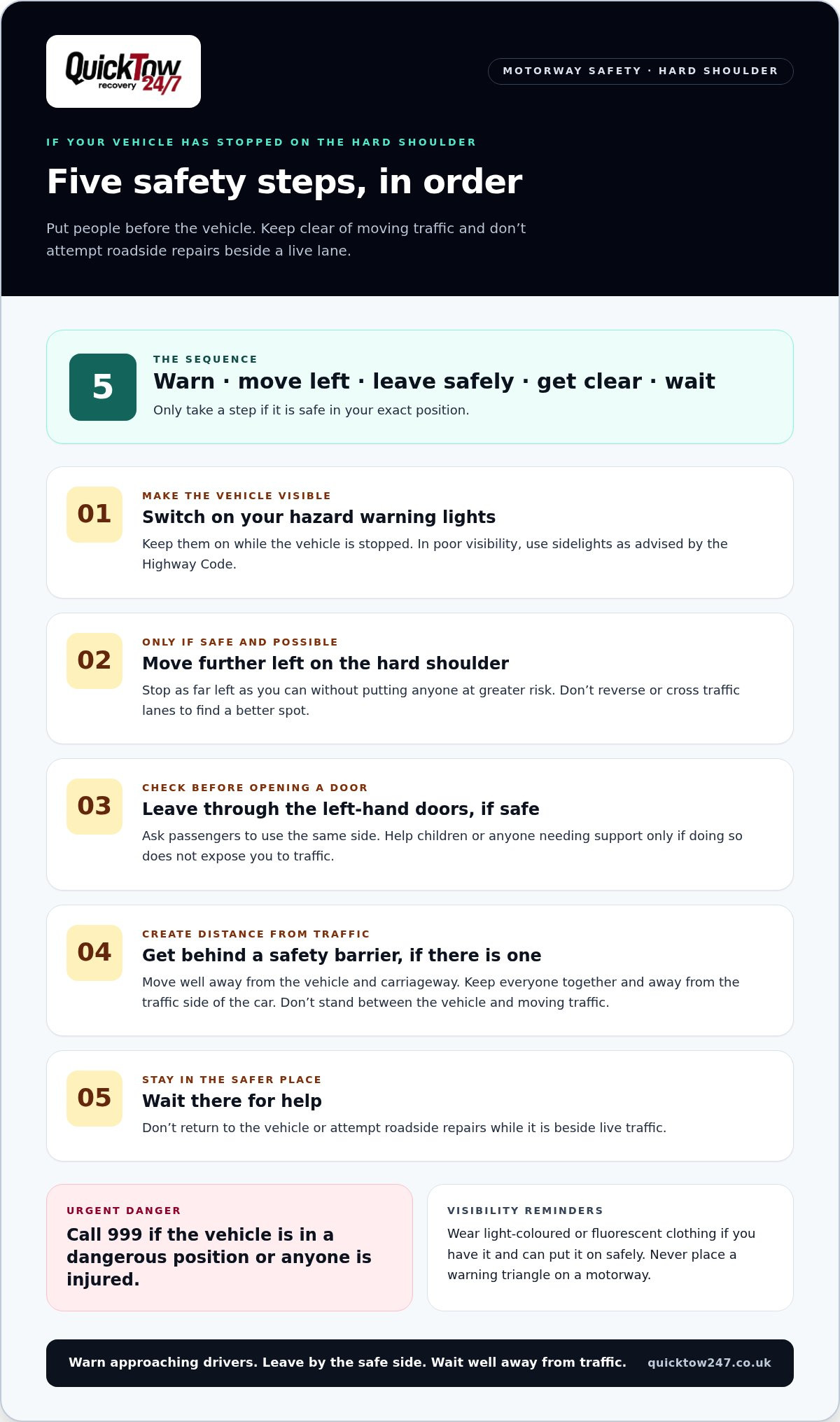
- Switch on your hazard warning lights. Use them while the vehicle is stopped to warn approaching drivers, especially if it’s obstructing the carriageway.
- Move further left only if it’s safe and possible. If the car can still be moved without putting anyone at greater risk, stop as far left on the hard shoulder as you can. Don’t reverse or cross traffic lanes to find a better spot.
- Leave through the left-hand doors if it’s safe to get out. Check for traffic before opening a door. Ask passengers to use the same side and help children or anyone who needs support, but don’t expose yourself to traffic to assist them.
- Get behind a safety barrier, if there is one. Move well away from the vehicle and the carriageway. Keep everyone together and away from the traffic side of the car. Don’t stand between the vehicle and moving traffic.
- Wait there for help. Don’t return to the vehicle or attempt roadside repairs while it’s beside live traffic.
How should you leave the vehicle and wait?
Leave only when you can do so safely. On a hard shoulder, use the doors furthest from traffic, usually the left-hand doors. Once outside, move away from both the vehicle and the carriageway, then wait behind a safety barrier if available. Keep passengers with you and out of the path of traffic. If getting out would put someone in greater danger, stay clear of the carriageway and contact emergency services for urgent help.
How do you make the stopped vehicle easier to see?
Keep the hazard lights on while the vehicle is stopped. In poor visibility, use sidelights as advised by the Highway Code. If you have light-coloured or fluorescent clothing, wear it when leaving the car, but don’t search for it or return to the vehicle if that would take you towards traffic. Never place a warning triangle on a motorway. The Highway Code says not to use one there.
Warn approaching drivers, leave by the safe side, then wait well away from the vehicle and traffic. Keep this order in mind, but don’t take a step that feels unsafe in your exact position.
When everyone is safely away from the carriageway, breakdown recovery can help arrange the vehicle’s next move. Arrange motorway breakdown recovery once you’re in a safe place.
No hard shoulder or stuck in a live lane? The next steps differ
On a motorway without a continuous hard shoulder, the usual roadside plan may not fit your situation. The motorway hard shoulder breakdown rules change with your position. An emergency area is a designated refuge; a live lane is still carrying traffic. Don’t try to reach an emergency area if getting there would put you or others in greater danger.
| Where you’ve stopped | What to prioritise |
|---|---|
| Hard shoulder | Use the hard-shoulder safety steps in the previous section. It is separate from the live lane, but traffic passes close by. |
| Emergency area | Follow the signs and instructions at the refuge. If it’s safe to leave, move behind the safety barrier and use the roadside SOS phone. |
| Live lane | Switch on hazard lights. If there’s immediate danger, contact emergency services. Leave the vehicle only if there’s a safe route away from traffic. |
What should you do if you reach an emergency area?
An emergency area is a signed refuge on some smart motorways. Unlike a continuous hard shoulder, it’s a specific stopping place set back from the live lanes. Check the signs and follow the instructions displayed there. If you can get out safely, use the doors away from traffic and move behind the barrier. Then use the emergency telephone, which connects you to the motorway control centre and helps identify your location. Follow the operator’s directions and don’t rejoin the motorway until you’ve been told it’s safe to do so.
Getting to an emergency area is not worth a dangerous manoeuvre. If traffic, the vehicle’s condition or its position makes the route unsafe, stay where you are and seek emergency guidance instead.
What if the vehicle stops in a live lane?
This is an urgent situation. Put the hazard warning lights on. If you’re creating an immediate danger or can’t get clear safely, call 999 and explain that the vehicle is stopped in a live lane. Give the motorway and direction of travel if you know them, along with any nearby sign or marker. Don’t cross lanes, walk through traffic or try to reach a refuge on foot.
Leave only if there’s a clear, safe route away from moving traffic. If the vehicle or traffic makes getting out unsafe, stay inside with your seatbelt fastened, keep the hazard lights on and follow the emergency operator’s instructions. Don’t improvise or assume that another lane is clear.
These situations can feel frightening, but focus on one decision at a time: identify whether you’re in a refuge or live lane, avoid any move that adds danger, then follow the official instructions for that location.
Motorway breakdown rules: avoid these dangerous mistakes
A breakdown can make familiar actions unsafe. A warning triangle or a quick look under the bonnet might seem sensible on an ordinary road, but beside motorway traffic they can put you directly in harm’s way. The motorway hard shoulder breakdown rules include clear Highway Code instructions. Other precautions can help reduce your exposure to traffic.
Highway Code instructions
Don’t place a warning triangle on a motorway. Highway Code Rule 276 says never to use one there. Don’t walk beside fast traffic to place one behind a broken-down vehicle, and don’t improvise with another warning device.
Rule 276 also warns against standing between a vehicle and oncoming traffic. A driver approaching at speed may not see you in time, and the vehicle offers no reliable protection if it’s struck. Keep away from the traffic-facing side of the car.
Sensible precautions on the hard shoulder
These steps support the Highway Code guidance. They aren’t a reason to approach the carriageway or put yourself at risk:
- Don’t wait beside the traffic-facing side of the vehicle. Move away from the car and behind a safety barrier if one is available. Keep passengers with you and away from moving traffic.
- Don’t attempt roadside repairs beside fast traffic. Changing a tyre, checking under the bonnet or retrieving items from the boot can leave you exposed. Wait for appropriate assistance rather than working beside the carriageway.
- Don’t walk along the carriageway. Never cross a live lane to reach an exit, phone or emergency area. Follow the instructions for the place where you’ve stopped.
- Don’t use the hard shoulder for routine stops. It isn’t a safe place for a phone call, route check, rest or passenger pick-up. Stop there only in an emergency.
A hard shoulder is separated from the live lane, but it isn’t a protected waiting area. Traffic can pass close by, and a vehicle may enter the shoulder unexpectedly. Treat it as a place to stop when necessary, not somewhere to remain beside the car while you decide what to do.
Keep the priority simple: follow the Highway Code, stay away from moving traffic and leave roadside work to recovery professionals. Once you and your passengers are in a safe place, arrange breakdown recovery to help move the vehicle on.
Once you are safe, arrange motorway breakdown recovery
Once you and your passengers are away from moving traffic, you can focus on what happens to the vehicle. If there’s immediate danger, an injury or the vehicle is obstructing a live lane, contact the emergency services first. For a vehicle in a safer position, clear location details help the recovery team understand where you are and what assistance may be needed.
What information should you give when requesting recovery?
Share your location before describing the mechanical problem. On a motorway, being on the correct side and direction of travel matters. A marker post, junction number, exit, service area or recognisable landmark can help pinpoint the vehicle. Say whether it’s on a hard shoulder, in an emergency area or in a live lane, and explain where you and your passengers are waiting.
Have these details ready if you can do so safely:
- Road location: motorway name or number, direction of travel, nearest junction, marker post or landmark.
- Vehicle position: hard shoulder, emergency area, live lane or another place, plus whether the vehicle is blocking traffic.
- Vehicle details: make, model, colour and registration number.
- Breakdown details: what happened, what the vehicle is doing now and whether it can move.
- People and hazards: number of passengers, anyone needing extra help, injuries, smoke or other immediate risks, and where everyone is waiting.
If you don’t know the exact marker, don’t guess. Give the nearest information you can see, such as a junction sign or service-area name. If you’re using an emergency area, tell the call handler and follow the roadside SOS phone instructions. Keep the phone conversation brief if you’re exposed or need to follow directions from emergency services.
How can QuickTow 24/7 help after a motorway breakdown?
Once people are in a place of relative safety, QuickTow 24/7 provides breakdown recovery and towing to help with the vehicle’s next move. The service is available 24/7, and recovery is fully insured. Share your precise location and explain any access or safety concerns clearly when arranging help. You can find us at quicktow247.co.uk.
Our services include:
- Nationwide vehicle transportation
- Recovery or towing
- Mobile tyre repair or changing
- Fuel delivery
- Jumpstart
- Mobile battery changing
- Vehicle pull out from mud, ice, or ditch
- Vehicle recovery from accidents or motorways
The motorway hard shoulder breakdown rules are there to help you manage the immediate risk. After that, give the recovery team the details they need and stay in your safe waiting place unless emergency services advise otherwise. If you need help arranging the vehicle’s recovery, Contact QuickTow 24/7 for recovery assistance.
Take the next step when you’re safely clear
A motorway breakdown can leave you shaken, so focus on one decision at a time. You don’t need to solve everything at once. Once you’re away from moving traffic, take a moment to steady yourself and make sure everyone is accounted for before arranging what happens next.
Keep the motorway hard shoulder breakdown rules in mind for future journeys, too. Knowing that your response depends on where the vehicle stops can make an unexpected problem easier to handle. If you travel with passengers, agree that everyone will follow your directions and avoid returning to the vehicle while it’s beside traffic.
When you’re ready to arrange help, share your location and explain where the vehicle is positioned. Request help with your vehicle’s recovery from QuickTow 24/7, then stay in your safe waiting place and follow any instructions you receive.
A breakdown is stressful, but you can take the next step calmly. Keep yourself and your passengers safe first, then deal with the vehicle.
Frequently Asked Questions
Can I stop on the motorway hard shoulder if my car has not broken down?
No, don’t use the hard shoulder for a routine stop. It’s for emergencies, such as a breakdown, or when directed by the police or traffic officers. If you need a rest, want to check something or feel unwell, leave the motorway at the next safe exit and stop somewhere suitable. On some smart motorways, a shoulder may be open to traffic, so never assume it’s available as a stopping place.
Can I use the hard shoulder to make a phone call or check directions?
No. A phone call or route check isn’t a reason to stop on the hard shoulder. Plan your route before setting off, or use a service area or a safe place off the motorway if you need to pause. If you’re already driving, don’t handle your phone or look at directions while moving. Ask a passenger to help, or wait until you’ve left the motorway safely.
What should I do if my hazard warning lights are not working after a motorway breakdown?
If the hazard lights fail, don’t step into traffic to investigate or try to fix them. If the vehicle can be moved safely, get it to a safer stopping place. If it can’t, follow the guidance for where it has stopped and contact emergency services if it’s creating immediate danger. Use working sidelights in poor visibility if you can do so safely. Don’t place a warning triangle on a motorway.
Can a motorcycle use the motorway hard shoulder during a breakdown?
A motorcycle shouldn’t use the hard shoulder as a shortcut or to avoid traffic. If it develops a fault, the rider should reach a safe stopping place only if they can do so without risk. Once stopped, follow the motorway hard shoulder breakdown rules and stay clear of moving traffic. Don’t try to push the motorcycle along the carriageway or stand beside it on the traffic-facing side.
What if a passenger cannot safely leave the vehicle on the hard shoulder?
Don’t force someone to get out if doing so would put them in greater danger. If they can’t leave safely, they should remain seated with their seatbelt fastened, and you should contact emergency services for guidance. Tell the operator who needs assistance and why they can’t exit. Keep other passengers together in a safer place if they can leave without creating additional risk.
Can I walk along the motorway hard shoulder to find help?
Don’t walk along the carriageway or wander away from the vehicle. If you need to use a motorway emergency telephone, do so only if you can reach it by a safe route. Follow the arrows on the marker posts and face the traffic as you walk. If the route feels unsafe, stay in a safer place and use a mobile phone to call for help instead.
Do motorway breakdown rules differ across the UK?
The core safety approach is similar across Great Britain, but Northern Ireland has its own Highway Code. Follow the code and road signs that apply where you’re driving, especially on smart motorways, where lane layouts and emergency areas affect what you should do. If you’re unsure of your location or the correct procedure, tell the emergency operator where you are and follow their instructions.